
What Is a Data Diode?
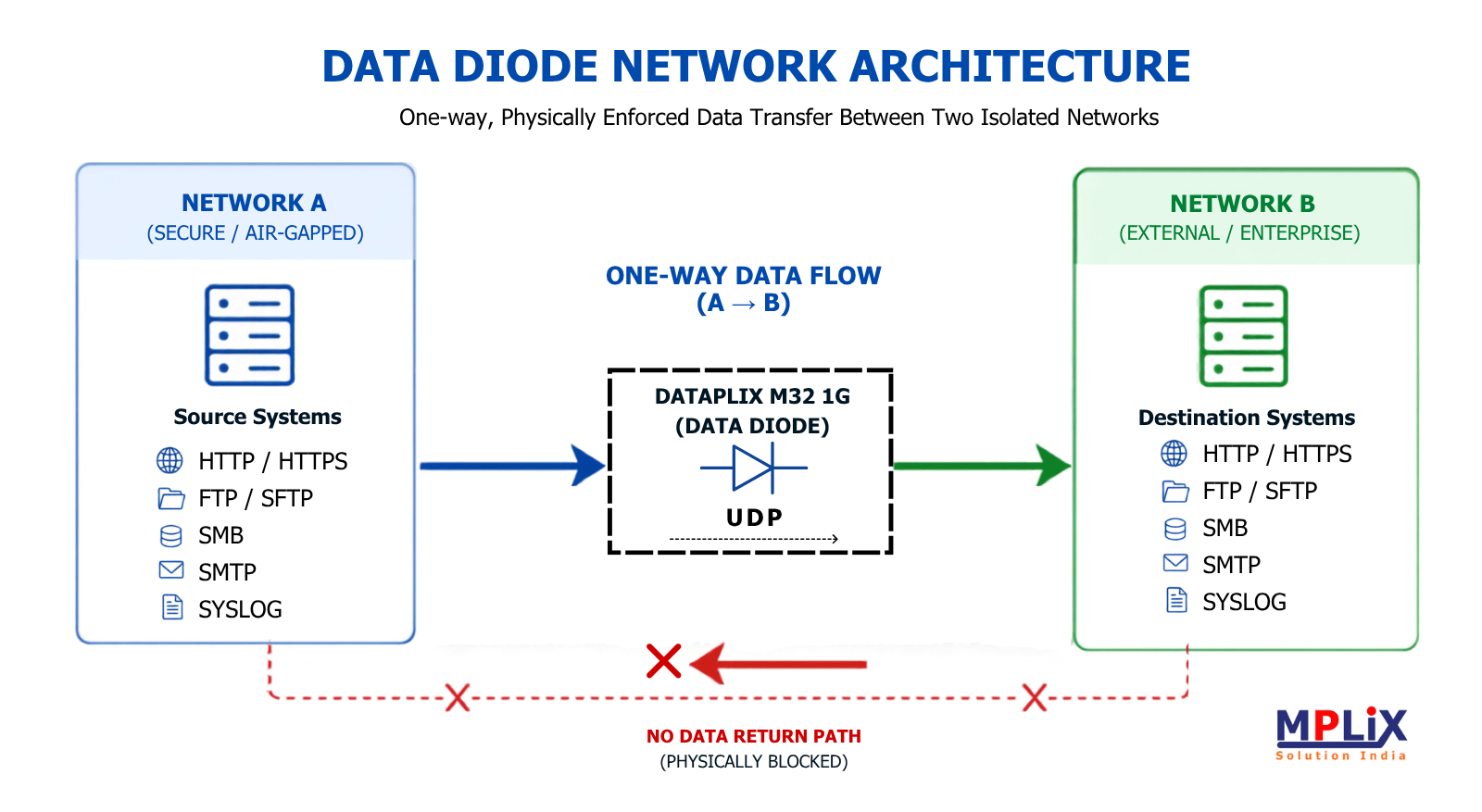
A data diode is a hardware cybersecurity device that allows information to travel in only one direction between two networks. Unlike traditional firewalls, routers, or VPN solutions, a data diode physically prevents reverse communication.
This hardware-enforced approach ensures that attackers cannot send commands, deploy malware, or establish remote access sessions into protected systems.
How Does a Data Diode Work?
A data diode consists of a transmitting side and a receiving side connected through a physical one-way communication channel.
Information can travel from the operational network to the business network, but data cannot travel in the opposite direction.
- Hardware transmitter
- Hardware receiver
- One-way communication link
- Protocol replication software
- Application proxies
- Industrial protocol support
The Hidden Risk Behind Convenience
Modern manufacturing facilities increasingly connect operational technology (OT) systems to corporate IT networks to improve visibility, enable analytics, and support remote operations. While these integrations provide operational advantages, they also create new cybersecurity risks.
In this fictional use case, we explore how a manufacturing company experienced a cyber incident after attackers moved from the corporate network into operational systems. Although the incident described here is fictional, the attack methods and cybersecurity risks are based on real-world industrial threats.
The Manufacturing Environment
The facility operated multiple production lines connected to industrial control systems, programmable logic controllers, and SCADA systems. To improve production reporting, operational data was continuously shared with business applications located on the corporate network.
The IT and OT environments were separated using firewalls and VLANs. Remote access was available for maintenance and engineering teams.
Attack Timeline
Day 1 – Phishing Attack
An employee receives a malicious email attachment that installs malware on a workstation.
Day 2 – Internal Reconnaissance
Attackers begin exploring the corporate network and identify systems connected to production operations.
Day 4 – Lateral Movement
The attackers exploit weak segmentation and move toward operational technology systems.
Day 5 – Production Impact
Critical manufacturing systems become unavailable, resulting in production downtime.
Why Traditional Security Controls Failed
Firewalls and network segmentation provide important protection, but they still rely on software rules and administrative configurations.
If an attacker gains access to trusted systems, stolen credentials, or remote access services, traditional defenses may no longer be sufficient.
Misconfigured firewall rules, VPN access, remote desktop services, and shared network resources can unintentionally create pathways between IT and OT environments.
How a Data Diode Could Have Prevented the Attack
In this scenario, attackers successfully compromised the corporate network and began searching for pathways into operational systems.
Because traditional network connections allowed bidirectional communication, attackers were eventually able to reach systems connected to production operations.
If a data diode had been deployed between the IT and OT environments, the attack path would have been physically blocked.
Data Diode vs Firewall
| Feature | Data Diode | Firewall |
|---|---|---|
| Communication | One-way | Two-way |
| Security Method | Hardware | Software Rules |
| Remote Access | Impossible | Possible |
| Attack Surface | Very Low | Moderate |
| Configuration Errors | None | Possible |
Data Diode vs Air Gap
Traditional air-gapped systems completely isolate networks by removing all communication paths.
While effective, air gaps often require manual file transfers, removable media, and limited operational visibility.
Data diodes provide many of the benefits of air-gapped environments while allowing continuous, secure data transfer.
Industries Using Data Diodes
Manufacturing
Production systems and industrial automation.
Energy
Power generation and transmission systems.
Oil & Gas
Refineries, pipelines, and offshore facilities.
Transportation
Railways, airports, and traffic systems.
Cybersecurity Standards Supporting Data Diodes
Many industrial cybersecurity frameworks emphasize network segmentation and secure communication boundaries.
- IEC 62443
- NIST SP 800-82
- NERC CIP
- ISO 27001
- NIST Cybersecurity Framework
How the Attack Reached OT Systems
The attackers discovered a reporting server responsible for transferring production data between operational systems and the corporate network.
Because the communication path allowed bidirectional traffic, attackers were able to access systems located closer to the production environment.
Once inside the OT network, malware spread to engineering workstations and impacted critical production processes.
How a Data Diode Could Have Prevented the Incident
A data diode enforces one-way communication through hardware. Information can move from the OT network to the business network, but reverse communication is physically impossible.
Even if the corporate network became compromised, attackers would have no physical communication path to send commands or malware into operational systems.
Benefits of Hardware-Enforced Security
Physical Isolation
Hardware-enforced one-way communication eliminates inbound attack paths.
Reduced Attack Surface
Attackers cannot establish remote sessions into protected systems.
Continuous Visibility
Production data can still be shared safely with enterprise applications.
Regulatory Compliance
Supports industrial cybersecurity standards and network segmentation requirements.
Lessons Learned
Industrial organizations continue to connect operational systems to business environments to improve efficiency and decision-making.
However, every connection introduces potential cyber risks. Organizations must evaluate whether software-based protections alone are sufficient for critical operations.
Data diodes provide a stronger security boundary by physically preventing reverse communication while still enabling essential data sharing.
Real-World Industrial Cyber Incidents
Although the manufacturing incident described in this article is fictional, similar attack methods have affected industrial organizations worldwide.
Over the past decade, ransomware groups and advanced cyber attackers have increasingly targeted manufacturing facilities, energy providers, transportation systems, and critical infrastructure organizations.
Many of these incidents involved attackers moving from corporate IT networks into operational environments through trusted communication paths, remote access systems, or poorly segmented networks.
These incidents demonstrate that traditional perimeter defenses alone may not provide sufficient protection for critical operational systems.
Deployment Considerations for Data Diodes
Deploying a data diode requires careful planning to ensure both security and operational requirements are met.
Organizations should evaluate:
- Required data transfer rates
- Supported industrial protocols
- Application compatibility
- Network architecture
- Redundancy requirements
- High availability needs
- Compliance requirements
Modern data diode solutions support a wide range of industrial protocols and applications, allowing organizations to maintain operational visibility while eliminating inbound cyber risks.
Industry 4.0 and Increasing OT Connectivity
Industry 4.0 initiatives continue to connect operational technology systems with business applications, cloud platforms, analytics engines, and remote monitoring services.
While these technologies improve efficiency and decision-making, they also increase the number of potential attack paths between IT and OT environments.
As digital transformation accelerates, organizations must balance operational visibility with cybersecurity requirements.
Data diodes provide a secure method for sharing operational information without exposing critical systems to external threats.
Why Your Organization Could Be a Prime Target for Cyberattacks
Cyber threats are no longer limited to large enterprises or government organizations. Today, any organization that relies on digital systems, operational technology, connected networks, or critical business operations can become a potential target.
As businesses continue to adopt cloud services, remote access solutions, industrial automation, and digital transformation initiatives, the number of communication pathways between systems continues to increase. While these technologies improve efficiency and productivity, they can also introduce new cybersecurity risks.
Attackers often look for organizations where operational disruptions can lead to financial losses, service interruptions, reputational damage, or safety concerns. Industries such as manufacturing, energy, transportation, healthcare, utilities, and critical infrastructure frequently face these risks, but organizations of all sizes may be affected.
Common attack methods include phishing emails, stolen credentials, vulnerable remote access systems, compromised third-party services, and improperly segmented networks. Once attackers gain access to a trusted system, they often attempt to move laterally through the environment in search of sensitive data, critical applications, or operational systems.
Modern organizations increasingly rely on the exchange of information between business networks and operational environments. While this connectivity enables better visibility, analytics, and decision-making, it can also create potential pathways for cyber threats if proper security controls are not in place.
As cyber threats continue to evolve, organizations must evaluate whether traditional software-based security measures alone are sufficient to protect critical assets, maintain operational continuity, and reduce the risk of unauthorized access.
Common Attack Paths Between IT and OT Networks
Attackers rarely begin their operations inside industrial environments. Instead, they typically enter through corporate systems and gradually move toward operational networks.
- Remote access services
- VPN connections
- Shared databases
- File transfer servers
- Historian systems
- Engineering workstations
- Remote maintenance systems
Every communication pathway between IT and OT environments represents a potential attack surface that must be carefully secured.
Typical Data Flows Protected by Data Diodes
Modern industrial organizations use data diodes to securely transfer operational information while preventing inbound communication.
Historian Data
Transfer production data to enterprise systems.
Security Logs
Forward OT logs to SIEM platforms.
Production Reports
Share manufacturing metrics safely.
Cloud Analytics
Provide secure outbound telemetry.
Signs That Your Organization May Need a Data Diode
- Critical systems connected to business networks.
- Remote monitoring requirements.
- Regulatory compliance obligations.
- Industrial control systems requiring isolation.
- Protection of critical infrastructure.
- Concerns about ransomware attacks.
- Need for secure data sharing.
Organizations responsible for continuous operations often require stronger security controls than traditional software-based defenses can provide.
Building a Zero-Trust OT Architecture
Zero-trust principles assume that no network connection should be automatically trusted. Every communication path must be verified and controlled.
In operational technology environments, data diodes support zero-trust architectures by eliminating unnecessary inbound communication paths.
By allowing only required outbound data flows, organizations can reduce attack surfaces while maintaining operational visibility.
As industrial cybersecurity strategies evolve, hardware-enforced one-way communication is becoming an important component of secure OT network design.
The Future of Hardware-Enforced OT Security
Traditional cybersecurity solutions rely heavily on software controls, rule sets, signatures, and monitoring systems. While these technologies remain important, they cannot completely eliminate communication pathways between networks.
Hardware-enforced security solutions such as data diodes provide a fundamentally different approach by physically preventing inbound communication.
As zero-trust architectures become more widely implemented, operational technology environments increasingly rely on security controls that provide provable isolation between systems and assets
Data diodes are expected to play an important role in protecting industrial systems, critical infrastructure, and highly sensitive environments in the years ahead.
Final Takeaway
The fictional manufacturing incident described in this article reflects real-world cybersecurity challenges faced by industrial organizations.
Attackers increasingly exploit trusted connections between corporate and operational networks to gain access to critical systems.
Data diodes provide one of the strongest security boundaries available because they physically eliminate the inbound attack path while allowing essential operational data to flow outward.
Industrial Cybersecurity by the Numbers
Industrial
cybersecurity reports continue to show manufacturing and critical infrastructure among the most targeted sectors for cyber attacks.
Manufacturing
Remains one of the most targeted sectors for ransomware attacks.
24/7 Operations
Industrial downtime can have significant operational and financial impact.
One-Way Security
Data diodes physically prevent inbound communication.
Conclusion
Although this manufacturing incident is fictional, the attack methods described are based on real-world industrial cyber threats.
Data diodes represent one of the strongest cybersecurity controls available for operational technology environments because they eliminate entire attack paths rather than attempting to detect or block attacks through software.
As industrial environments become increasingly connected, hardware-enforced one-way communication will play an important role in protecting critical infrastructure.
Frequently Asked Questions
Can a data diode be hacked?
Because reverse communication is physically blocked, attackers cannot establish inbound connections.
Are data diodes better than firewalls?
For highly secure industrial environments, data diodes provide stronger protection.
Where are data diodes used?
Manufacturing, energy, defense, transportation, healthcare, and critical infrastructure.
What protocols work with data diodes?
Syslog, OPC UA, MQTT, historian replication, and secure file transfer.
Secure Your OT Environment with DataPlix
Discover how hardware-enforced one-way communication can protect critical infrastructure and industrial operations.
Explore DataPlix SolutionsOur Data Diode Solution
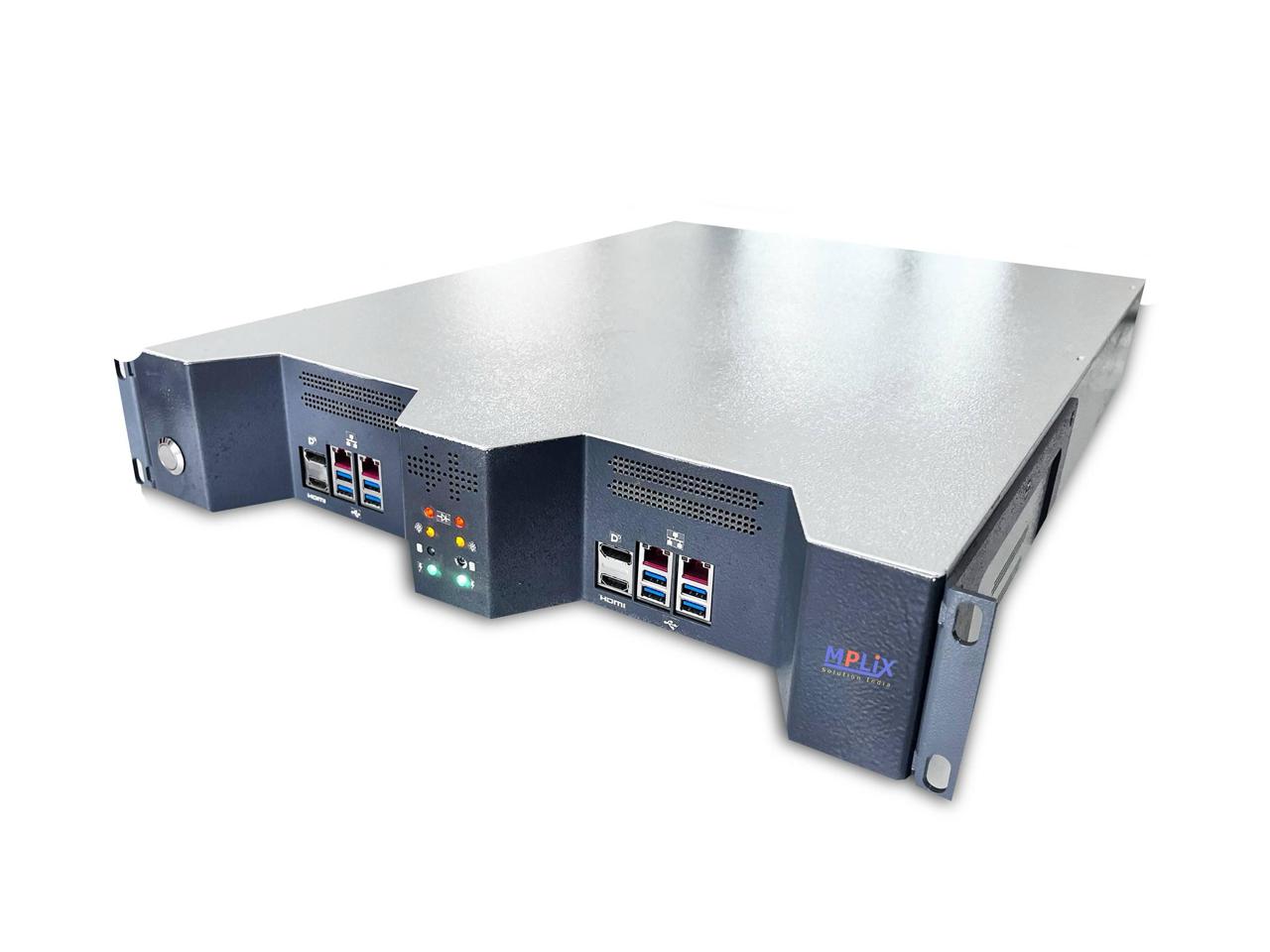
MPLIX offers hardware-based Data Diode solutions designed to provide secure one-way data transfer for critical infrastructure, industrial networks, OT environments, and air-gapped systems.
DataPlix-S45
DataPlix-S45 is a high-assurance hardware Data Diode engineered for secure unidirectional data flow. It helps organizations protect critical assets, OT networks, SCADA systems, and sensitive infrastructure from cyber threats while maintaining operational visibility.
- • Hardware-Enforced Security
- • One-Way Data Transfer
- • Industrial & Critical Infrastructure Protection
- • 10Gbps Throughput