As cyber threats continue to evolve, organizations responsible for Operational Technology (OT) and critical infrastructure face increasingly sophisticated attacks. Industries such as power generation, oil and gas, manufacturing, water treatment, transportation, healthcare, defense, and government rely on secure and resilient networks to maintain uninterrupted operations.
Traditional IT security solutions alone are no longer sufficient to protect industrial environments. Cyberattacks targeting Industrial Control Systems (ICS) and Supervisory Control and Data Acquisition (SCADA) networks can disrupt essential services, cause financial losses, and even compromise public safety.
Two of the most widely used technologies for securing these environments are Firewalls and Data Diodes. Although both play an important role in cybersecurity, they are designed to solve different security challenges.
A firewall monitors and controls network traffic using configurable software rules, while a data diode physically enforces one-way communication, making reverse data flow impossible.
In this article, we'll explore the differences between firewalls and data diodes, how they work, their advantages and limitations, and why data diodes have become an essential component of modern OT cybersecurity.
Understanding OT Security
Operational Technology (OT) refers to hardware and software that monitor or control physical devices, industrial processes, and critical infrastructure. Unlike traditional IT systems that primarily manage information, OT systems directly control equipment such as turbines, production lines, substations, pipelines, and water treatment facilities.
Common OT environments include:
- Power Plants
- Manufacturing Facilities
- Oil & Gas Refineries
- Water & Wastewater Treatment Plants
- Railway Systems
- Airports
- Smart Grid Infrastructure
- Industrial Automation Systems
Because these environments directly affect physical operations, maintaining availability, integrity, and safety is often more important than confidentiality alone. As a result, OT cybersecurity requires specialized security technologies that go beyond conventional IT protection.
What is a Firewall
A firewall is a network security device or software application that monitors and filters incoming and outgoing network traffic according to predefined security policies.
Its primary purpose is to prevent unauthorized access while allowing approved communication between trusted and untrusted networks.
Firewalls are commonly used to:
- Filter network traffic
- Block malicious connections
- Prevent unauthorized access
- Enforce network security policies
- Monitor communication
- Support secure remote access through VPNs
Modern organizations typically deploy several types of firewalls, including:
- Packet Filtering Firewalls
- Stateful Inspection Firewalls
- Proxy Firewalls
- Next-Generation Firewalls (NGFW)
How Does a Firewall Work
A firewall examines every packet traveling across a network and compares it against predefined security rules.
Depending on those rules, the firewall may:
- Allow traffic
- Block traffic
- Perform deep packet inspection
- Log communication
- Detect suspicious behavior
Because firewalls inspect both incoming and outgoing traffic, communication remains bidirectional.
While highly effective, firewalls rely on software, firmware, operating systems, and continuously updated security rules. Incorrect configurations or software vulnerabilities can reduce their effectiveness.
What is a Data Diode
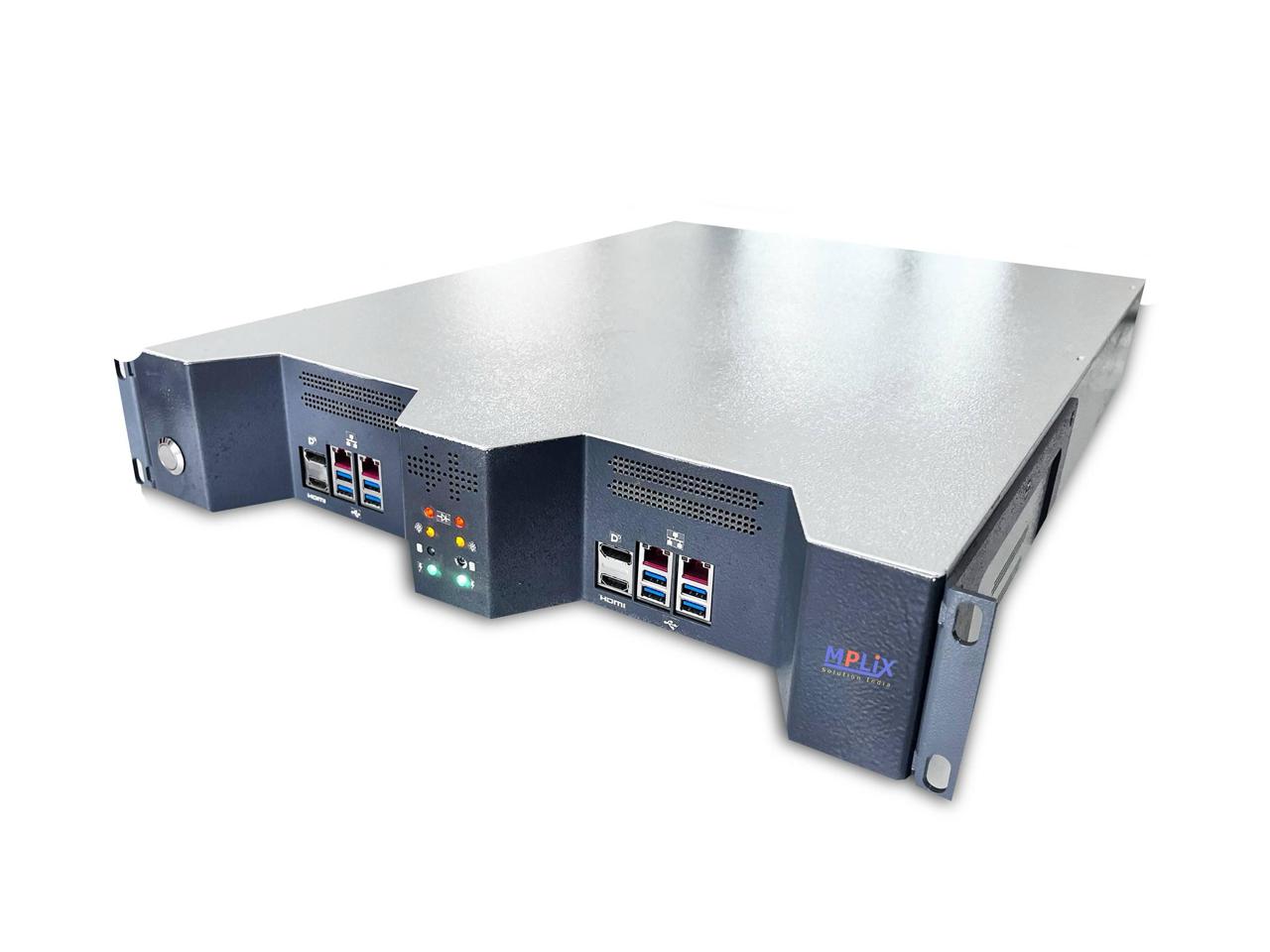
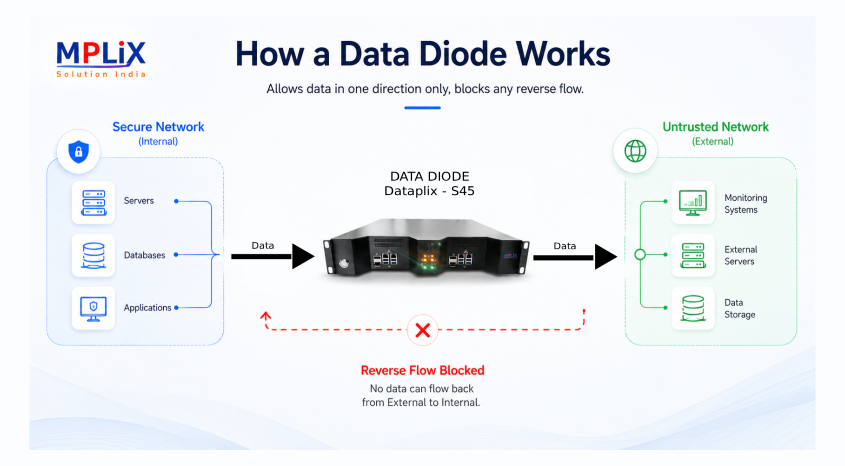
A Data Diode is a hardware-based cybersecurity device that physically enforces one-way (unidirectional) communication between two networks.
Unlike a firewall, which decides whether traffic should pass, a data diode physically prevents data from traveling in the opposite direction.
If information is allowed to flow from an OT network to an external monitoring system, there is no physical path that allows data or commands to return.
This hardware-enforced architecture makes data diodes one of the most secure solutions for protecting industrial control systems and critical infrastructure.
How Does a Data Diode Work
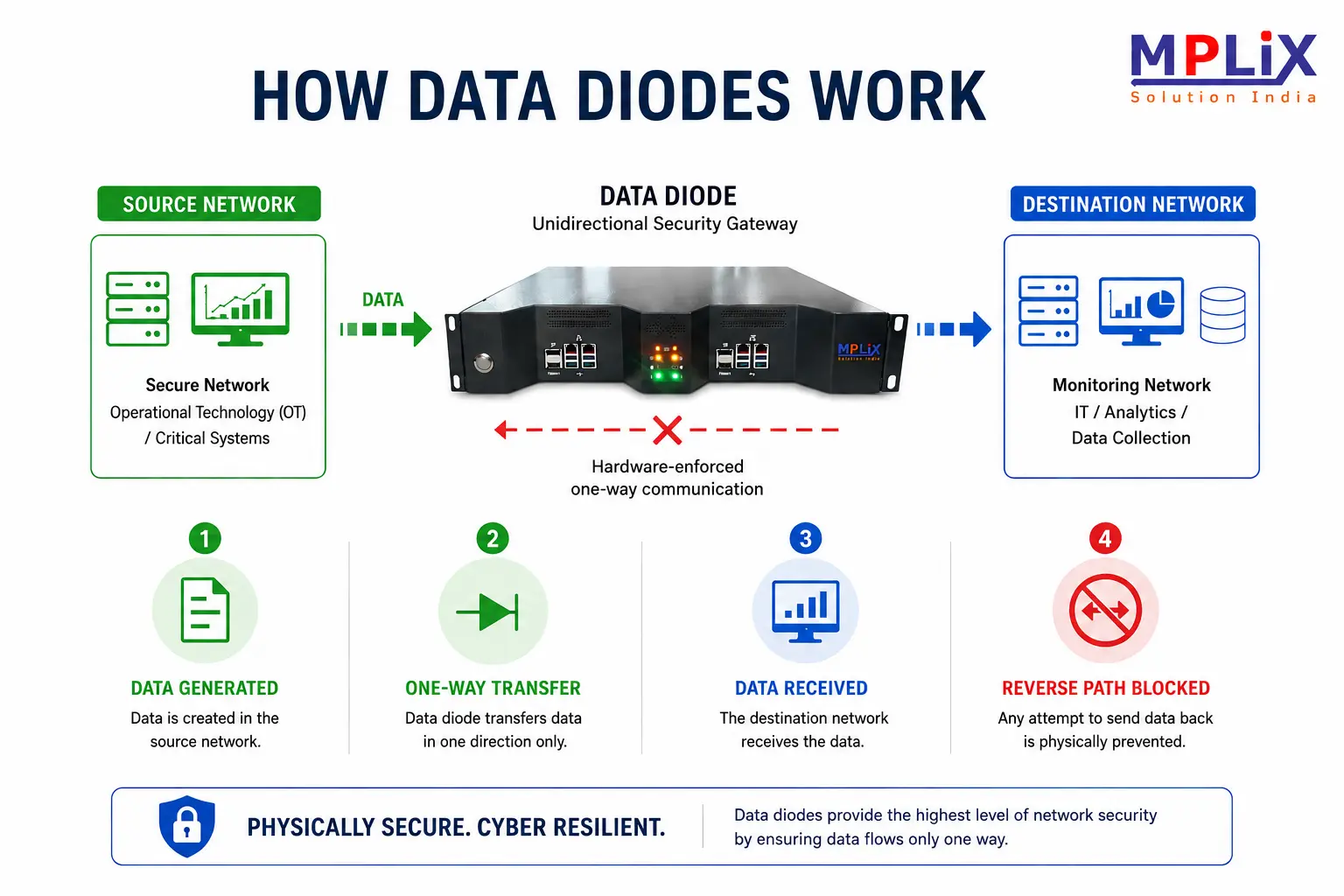
A data diode contains dedicated hardware that provides only a Transmit (TX) path on one side and only a Receive (RX) path on the other.
Because no return channel exists, reverse communication is physically impossible.
Even if attackers successfully compromise the receiving network, they cannot send malware, commands, or ransomware back into the protected OT environment.
Unlike software-based security controls, this protection cannot be bypassed through configuration changes or network exploits.
Firewall vs Data Diode Feature Comparison
| Feature | 🛡 Firewall | 🔒 Data Diode |
|---|---|---|
| Communication | Two-way | One-way only |
| Security Type | Software & Rules | Hardware Enforced |
| Reverse Communication | Allowed (Controlled) | Physically Impossible |
| Attack Surface | Higher | Extremely Low |
| Malware Protection | Can Detect / Block | Prevents Inbound Attacks |
| Remote Access | Supported | Not Supported |
| Configuration | Continuous Updates | Minimal Configuration |
| Risk of Misconfiguration | High | Very Low |
| Critical Infrastructure | Moderate | Excellent |
| Software Dependency | High | Minimal |
Advantages of Firewalls
Firewalls remain a fundamental part of enterprise cybersecurity because they provide flexible network security.
- Flexible Access Control: Organizations can create custom rules to permit or deny specific network traffic.
- Comprehensive Monitoring: Firewalls generate detailed logs and provide visibility into network activity.
- Threat Detection: Modern Next-Generation Firewalls include intrusion prevention, malware detection, and application awareness.
- VPN Support: Firewalls enable secure remote access for employees and administrators.
- Enterprise Integration: They integrate easily with cloud services, enterprise applications, and existing IT infrastructure.
Limitations of Firewalls
Despite their flexibility, firewalls have several limitations in OT environments.
- Software Vulnerabilities: Firewalls depend on software and firmware that may contain exploitable vulnerabilities.
- Configuration Errors: Misconfigured firewall rules remain one of the leading causes of cybersecurity incidents.
- Zero-Day Attacks: Previously unknown vulnerabilities can bypass firewall protections before security patches are available.
- Insider Threats: Firewalls cannot completely prevent attacks originating from authorized users or compromised credentials.
- Bidirectional Communication: Because firewalls permit two-way communication, attackers may exploit legitimate sessions to gain unauthorized access.
Advantages of Data Diodes
Data diodes provide a fundamentally different security model.
- Hardware-Enforced Security: Security is guaranteed through physical hardware rather than software rules.
- One-Way Communication: Reverse communication is physically impossible.
- Protection Against Ransomware: External attackers cannot transmit ransomware or malicious commands into protected OT networks.
- Extremely Small Attack Surface: Without inbound communication, opportunities for cyberattacks are dramatically reduced.
- Compliance with Industrial Standards: Data diodes help organizations meet stringent cybersecurity requirements for critical infrastructure and industrial environments.
Limitations of Data Diodes
Although highly secure, data diodes are designed for specialized applications.
- No Interactive Communication: Applications requiring acknowledgments or two-way communication may require protocol replication software.
- Limited Remote Administration: Direct remote management across the diode is generally not possible.
- Specialized Deployment: Data diodes are intended for high-security industrial environments rather than conventional office networks.
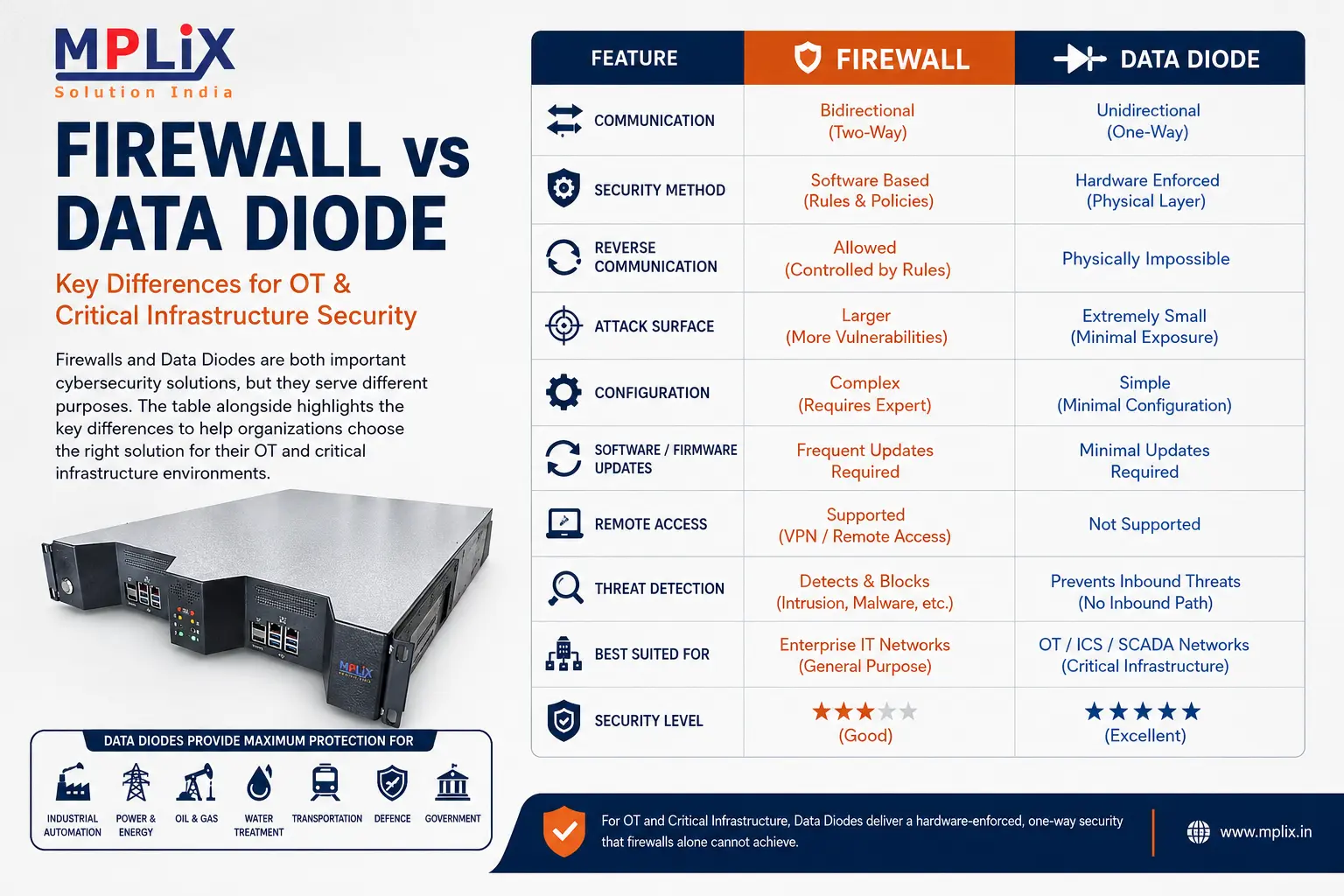 Comparison of bidirectional firewall communication and hardware-enforced one-way communication using a Data Diode.
Firewall vs Data Diode in OT Networks
Consider a power generation facility that needs to send operational data to a central monitoring center.
Using a Firewall
- The monitoring system exchanges data with the OT network through firewall rules.
- Although traffic is controlled, communication remains bidirectional.
- If firewall policies are compromised or credentials are stolen, attackers may gain access to operational systems.
Using a Data Diode
- Operational data flows only from the OT network to the monitoring center.
- Even if attackers completely compromise the monitoring network, they cannot send commands back into the operational environment because no physical return path exists.
- This architecture significantly reduces cyber risk and is widely adopted in critical infrastructure.
Industries That Use Data Diodes
Data diodes are commonly deployed across industries where cybersecurity failures could have serious operational consequences.
These include:
- Power Generation
- Oil & Gas
- Water Treatment Facilities
- Nuclear Energy
- Defense Organizations
- Government Agencies
- Manufacturing Plants
- Railway Infrastructure
- Airports
- Healthcare Systems
- Financial Institutions
- Data Centers
Should You Choose a Firewall or a Data Diode
The right choice depends on your operational requirements.
A Firewall is best suited for organizations that require:
- Internet connectivity
- Secure remote access
- VPN connectivity
- User authentication
- Bidirectional communication
- Application-level traffic inspection
A Data Diode is the preferred choice when your organization requires:
- Maximum cybersecurity
- OT network isolation
- Secure data export
- Hardware-enforced one-way communication
- Protection of Industrial Control Systems (ICS)
- SCADA security
- Critical infrastructure protection
- Compliance with industrial cybersecurity standards
Many organizations deploy both technologies as part of a Defense-in-Depth strategy, using firewalls for enterprise IT networks and data diodes to protect high-value OT environments.
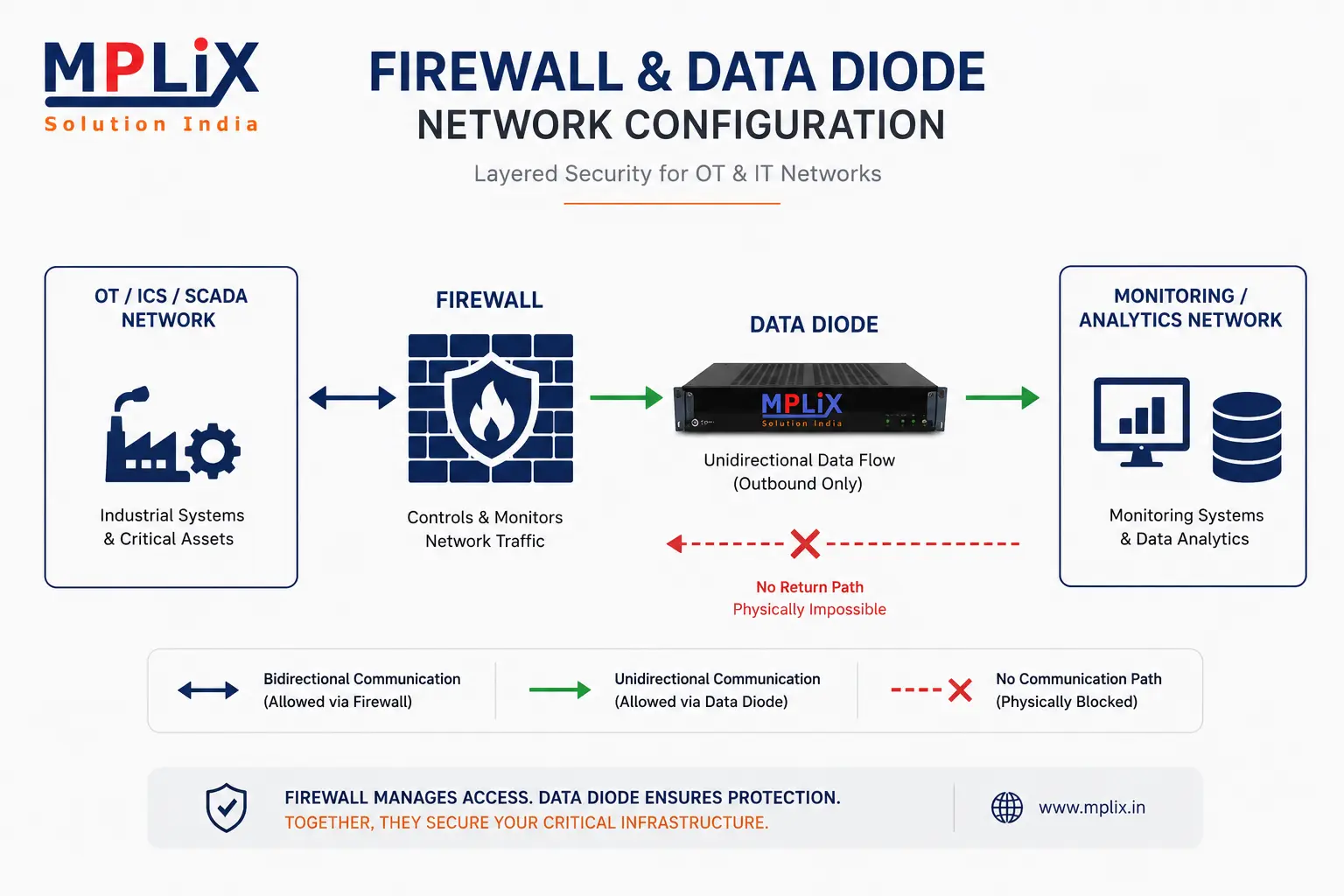 Data Diode and firewall configuration for secured IT & OT networks.
Frequently Asked Questions
1. Is a data diode more secure than a firewall?
Yes. A data diode provides stronger protection against inbound cyber threats because it physically prevents reverse communication. Firewalls rely on configurable software rules, which may be vulnerable to misconfiguration or software exploits.
2. Can a data diode replace a firewall?
Not entirely. Firewalls manage bidirectional communication and application access, while data diodes enforce one-way communication. In many OT environments, both technologies are deployed together for layered protection.
3. Why are data diodes used in OT security?
OT environments require maximum protection because they control physical infrastructure. Data diodes ensure operational networks remain isolated while allowing essential process data to flow outward for monitoring and analysis.
4. Are data diodes suitable for office networks?
Yes, when there is a need to protect highly sensitive or mission-critical information. While standard office networks typically rely on firewalls due to their need for continuous two-way communication, data diodes are an excellent choice for organizations that require secure one-way data transfer, such as government agencies, defense organizations, financial institutions, healthcare, research facilities, and enterprises handling sensitive intellectual property.
Conclusion
Firewalls and data diodes are complementary technologies that address different cybersecurity requirements.
Firewalls provide flexible traffic management, application awareness, and secure connectivity for enterprise IT environments. Data diodes, on the other hand, deliver hardware-enforced one-way communication that physically eliminates inbound cyber threats.
For organizations operating Operational Technology (OT), Industrial Control Systems (ICS), SCADA networks, and critical infrastructure, data diodes provide a level of protection that software-based firewalls alone cannot achieve.
As cyber threats targeting industrial environments continue to increase, combining firewalls with data diodes as part of a layered Defense-in-Depth strategy offers the highest level of resilience, ensuring that critical operations remain secure, reliable, and protected against evolving cyber risks.